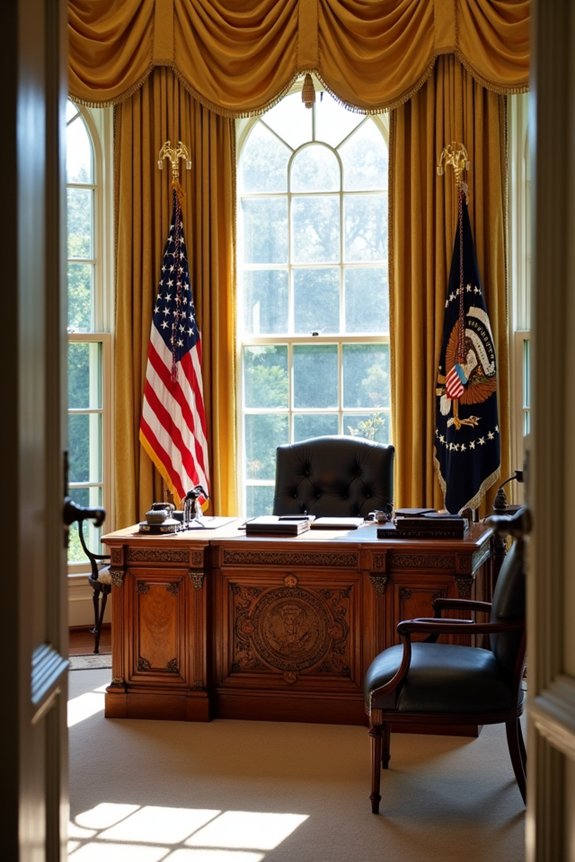
I’ve toured formal spaces, and here’s what strikes me: the Oval Office nails seven design moves that communicate authority with restraint. The oval shape itself puts everyone on equal footing. Gold trim catches light everywhere—ceilings, doorframes, the marble mantle. Soft beiges and creams let gilded details stand out. Dark wood bookcases add serious visual weight. That famous Resolute desk anchors the room’s center. Matching high-back chairs facing the fireplace signal respect between conversations. Presidential portraits establish legacy. Each element layers meaning into how power actually feels.
The Oval Shape: Why Presidential Geometry Commands Authority
Why does a room’s shape matter so much? I’ll tell you—it changes how you feel the moment you walk in. The Oval Office’s geometry isn’t accidental. When Eric Gugler redesigned the West Wing in 1933–34, he chose an oval instead of something rectangular, and that choice shaped presidential space forever.
The oval design does something distinctive: it creates equality. Those two high-back chairs facing the fireplace? They’re positioned so everyone sits at the same level, no hierarchy. The surrounding architecture reinforces this with symmetry—deep cornices, pedimented doors, built-in bookcases all flowing together.
Even the Taft Oval Office before it hinted at this direction. But the modern oval became iconic because its geometry conveys authority while embracing inclusion. That’s effective design.
Gold Trim and Reflective Surfaces: Materials That Amplify Formality
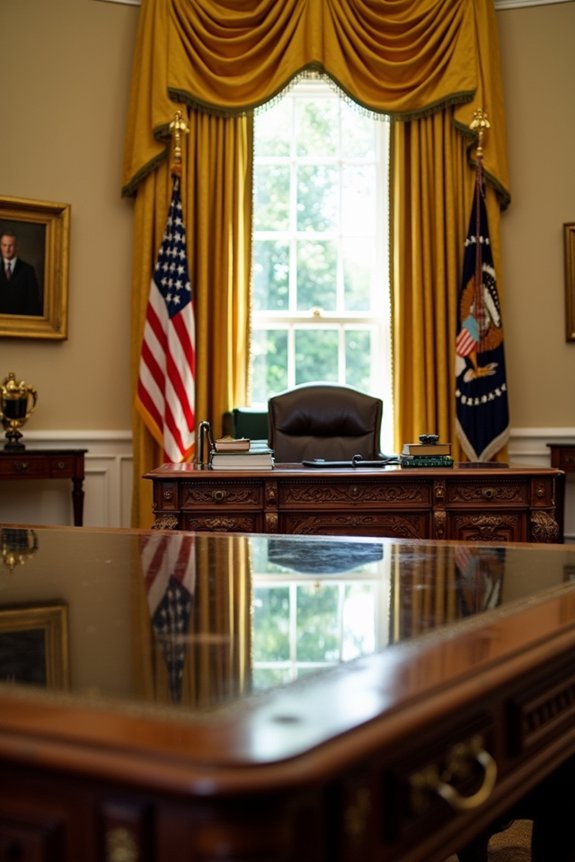
While that oval geometry whispers authority through shape alone, the Oval Office gets its real punch from what covers its surfaces. I’ve noticed how gold trim and reflective surfaces affect a room’s entire feeling. The Oval Office features extensive gilding across ceilings, door frames, and the marble mantle—creating focal points that catch your eye immediately. Gold-trimmed crown molding and cherubim accents amplify the ceremonial decor’s formality. Here’s what makes these materials work:
| Element | Impact |
|---|---|
| Gold trim | Draws attention upward |
| Reflective surfaces | Multiplies light throughout |
| Gilded carvings | Creates visual richness |
| Marble mantle | Centers the room |
| Crown molding | Frames architectural space |
When you’re designing formal spaces, these reflective materials signal importance. The gilding work—handled by specialized craftspeople—demands precision. You’re not just adding color; you’re creating visual sophistication that makes people feel they’ve entered somewhere genuinely significant.
The Restrained Palette: Beige, White, and Dark Wood
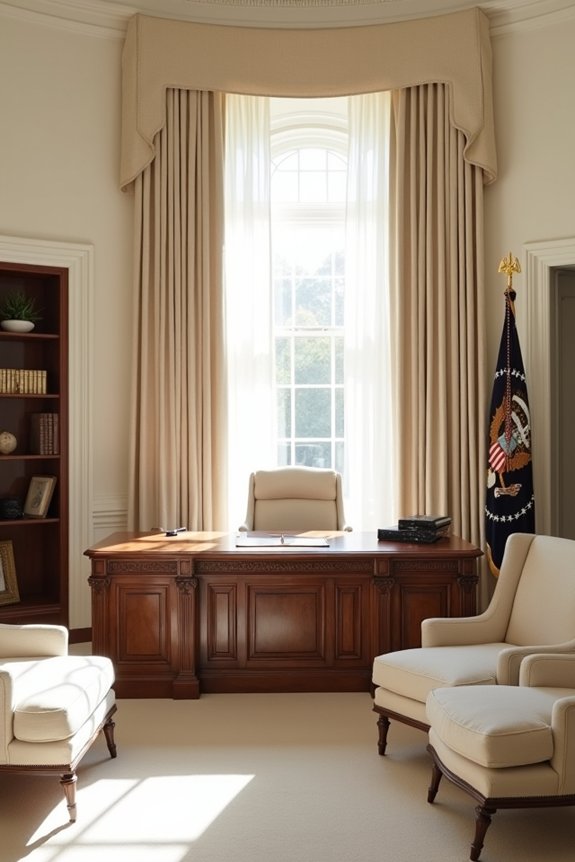
I’ve found that the Oval Office’s restrained palette—dominated by soft beiges, creamy whites, and rich dark woods—creates a lasting backdrop that won’t look dated in five years or fifty. When I’ve worked with similar color schemes in formal spaces, I’ve noticed that keeping walls in the 2000-3000K warm white range and selecting dark wood finishes like walnut or mahogany for flooring and built-ins creates architectural bones that feel both serious and inviting. These neutral tones work because they let gilded details, artwork, and meaningful objects become the real focus, rather than competing with bold paint colors or trendy finishes.
Neutral Tones and Timelessness
How does a room stay relevant across decades of change? The Oval Office demonstrates the answer through understated restraint. The neutral palette—beige, white, and dark wood—creates longevity that moves beyond momentary fashion. Walls typically wear soft creams (Benjamin Moore’s Swiss Coffee or comparable options) paired with rich mahogany or walnut furnishings. This pairing anchors the space without asserting dominance.
What stands out? These colors function regardless of who occupies the room. Beige upholstery adapts to different administrations’ preferences while preserving formality. Dark wood prevents the space from feeling sparse or unwelcoming. This palette works well in formal settings—it communicates authority through restraint rather than assertion, demonstrating that classical design endures.
Wood Finishes and Architectural Details
Dark wood fills the Oval Office—from the neoclassical mantel carved in deep mahogany to the built-in bookcases with their sturdy Georgian detailing. These wood finishes create warmth without overwhelming the space. The dark wood tones ground the room, establishing a sense of purpose and stability.
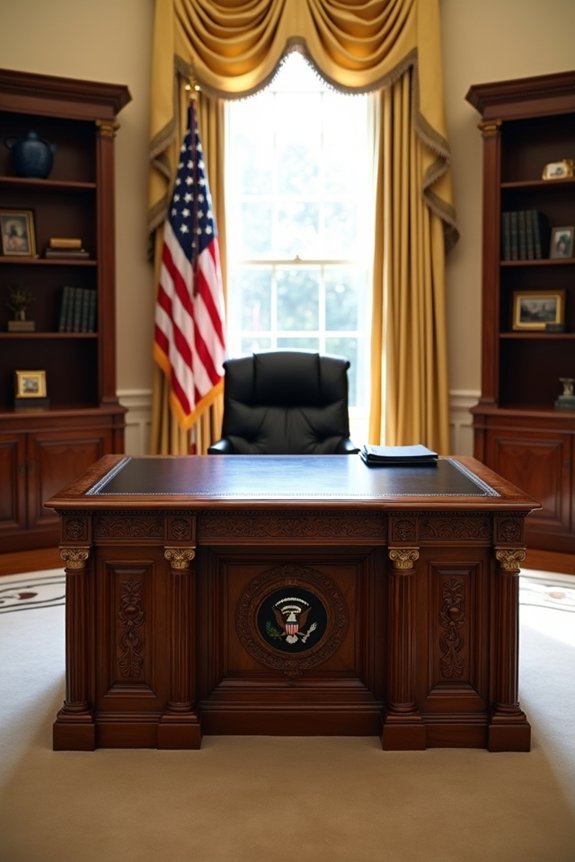
The Resolute desk occupies the center position, its timber-rich surface commanding respect through quiet craftsmanship. The wood veneers catch light subtly, highlighting quality over flash. Built-in bookcases frame the walls with traditional detailing that conveys sophistication through restraint rather than proclamation.
This approach functions well in both formal and casual spaces when wood finishes remain consistent throughout. The neoclassical mantel demonstrates that architectural details warrant serious consideration. Quality wood pieces provide enduring value across decades.
Built-In Bookcases and Architectural Detail: Density as Visual Weight
When you step into the Oval Office, you’re immediately struck by how the Georgian details and craftsmanship work together to make the space feel important and considered. Eric Gugler’s 1933–34 redesign brought in deep cornices and pedimented doors that frame the room like a gallery, while the built-in bookcases—flanking those south windows with their dark wood tones—create vertical lines that draw your eye upward and add real weight to every wall. I’ve found that cornice molding and careful casework like this establish a visual hierarchy that tells you this isn’t just any office; it’s a place where serious decisions happen.
Georgian Details And Craftsmanship
Why does the Oval Office feel so commanding the moment you step inside? I’d argue it’s the Georgian details working together. The heavy molding frames everything beautifully, while pedimented doors add architectural gravity that makes you stand taller.
What really gets me is how the built-in bookcases anchor the room. They’re not afterthoughts—they’re integral to the space’s bones. The neoclassical mantel, salvaged after the 1929 fire, brings historical weight and craftsmanship that you can’t replicate.
Above it all, the plaster ceiling medallion with presidential seal elements ties everything together. I’ve learned that this layered approach—combining molding, cabinetry, and decorative elements—creates visual density that feels deliberate and welcoming, not stuffy. That’s what makes this work here.
Cornice Molding And Visual Hierarchy
The cornice—that deep crown molding that runs around the room’s perimeter—serves a functional purpose I didn’t fully appreciate until I studied how light moves through the Oval Office. Hidden bulbs wash soft illumination across the ceiling, creating a subtle glow. This cornice molding works as a visual anchor for the room’s hierarchy.
The neoclassical aesthetic relies on vertical density. Built-in bookcases flanking the fireplace direct your eye upward, reinforcing formality. The ceiling medallion, installed in 1934, incorporates presidential seal elements and completes this upward movement. Dense molding around doors and windows distributes visual weight while maintaining symmetry.
Multiple layers of intentional design work in concert. That pronounced vertical density serves a purpose—it reinforces ceremonial stature and creates a sense of belonging within a space designed for significance.
The Resolute Desk: Centerpiece and Historical Anchor
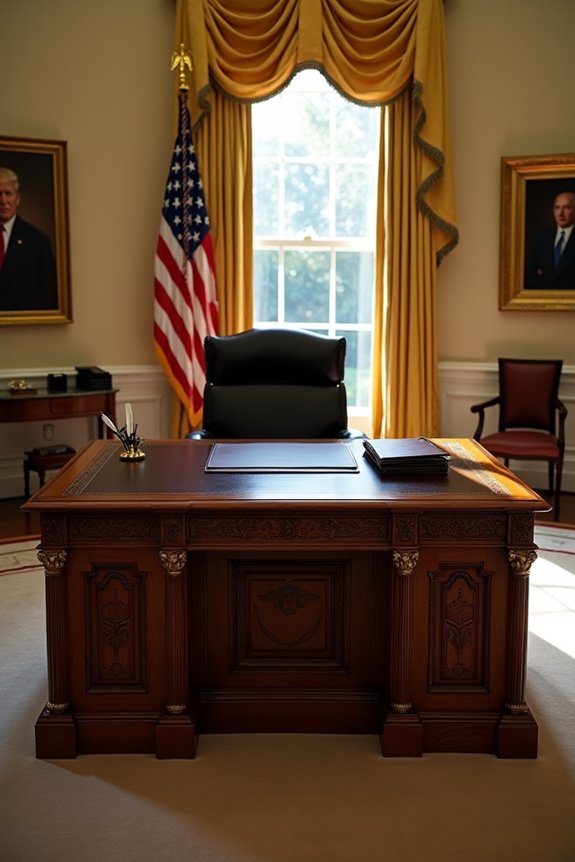
Ever notice how a single piece of furniture can hold an entire room’s story? The Resolute desk does exactly that in the Oval Office. Built from HMS Resolute timbers and designed by Morant, Boyd, & Blanford in 1880, this presidential desk carries historical weight and significance. Jacqueline Kennedy moved it into the Oval Office in 1961, establishing it as the centerpiece we know today. After touring the country following JFK’s assassination, it returned in 1977 under Carter. The desk carries Franklin D. Roosevelt’s kneehole modification, showing how each president left their mark. Eight presidents have used it since 1977, except George H. W. Bush. When you sit at that desk, you’re literally connected to decades of American leadership and decision-making.
Symmetrical Seating: Furniture as Subtle Power Dynamic
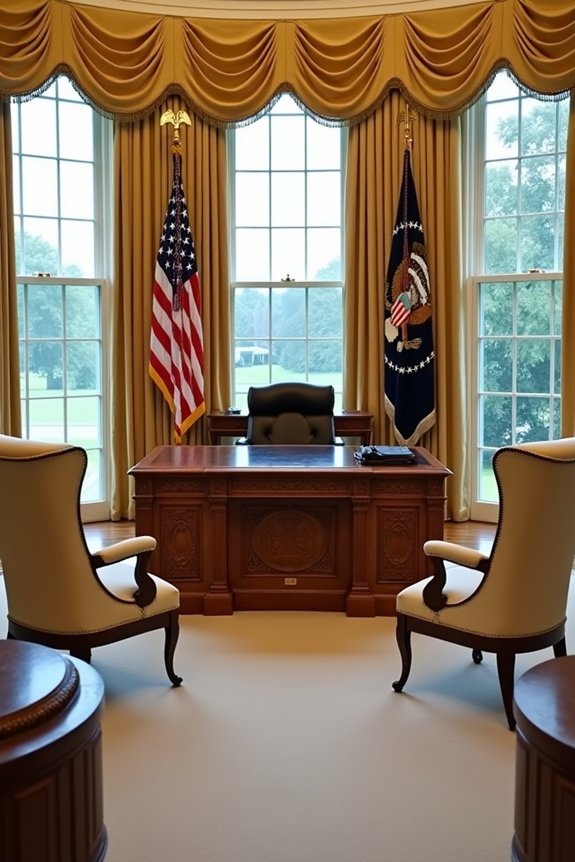
How’s this for a design choice with real impact? The Oval Office centers on two high-back chairs facing the fireplace, positioned with intentional symmetry. You’ll notice the president sits left, the guest right—creating balanced sightlines that avoid hierarchy. I’ve observed how this setup matters. When you’re seated at the same level, in matching chairs, something shifts in conversation. There’s reciprocal respect built into the furniture itself. These paired seating arrangements, maintained across administrations, signal egalitarian spatial psychology. The fireplace warmth, the symmetrical positioning, the sight lines—they’re all working together. You’re not beneath anyone here; you’re beside them. That’s the quiet power of thoughtful design in the Oval Office.
Presidential Portraiture: How Art Establishes Lineage and Control
When you step into the Oval Office, you’re not just seeing paintings on walls—you’re looking at a president’s statement about who they are and where they stand in history. Each president carefully selects Oval Office portraits and wall art from the White House Collection to tell their unique story. Since 1961, roughly 43 paintings have rotated through this iconic space.
I’ve observed how presidents use these art displays strategically. They flank the Resolute desk with pieces that matter to them personally. Obama honored Lincoln with specific portraits and busts. Kennedy surrounded himself with War of 1812 naval battles. These choices are deliberate statements about presidential lineage and values that connect them to America’s past.
| President | Featured Portrait |
|---|---|
| Washington | Rembrandt Peale |
| Kennedy | Naval Battle Scenes |
| Clinton | Hassam’s Avenue |
| Obama | Lincoln Tributes |
| Current | Declaration Display |