To write off office decorations, you need exclusive workspace use and self-employment status. Deductible items—like desk lamps for task lighting or curtains reducing glare—must serve genuine business purposes, not just look nice. Direct expenses are fully deductible; indirect ones get prorated by your office’s percentage of total home square footage. Document everything with receipts, photos, and business-function descriptions.
The simplified method costs $5 per square foot up to 300 square feet, while actual expenses yield larger deductions with proper tracking. Additional strategy exists for maximizing these deductions.
Does Your Home Office Qualify for Deductions?
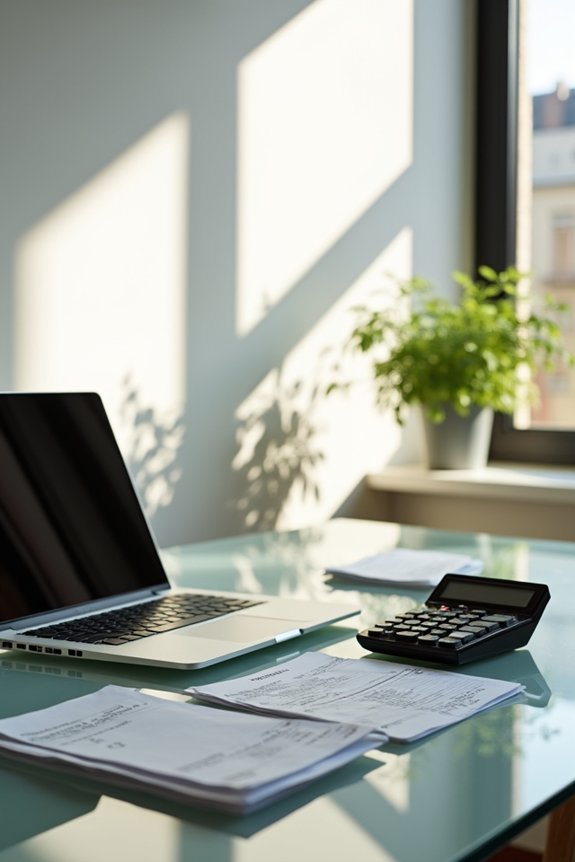
Before you start tallying up what you’ve spent on that new desk lamp or filing cabinet, let’s figure out if your home office actually qualifies for tax deductions in the first place.
Before claiming home office deductions, determine if your workspace qualifies for tax purposes.
Here’s the thing: you need exclusive use of a dedicated workspace for business activities. That means your home office can’t double as a guest bedroom or craft room. I learned this the hard way when the IRS questioned my den setup—turns out, occasional use doesn’t qualify.
You’ll also need to be self-employed or a business owner. If you’re an employee working from home, unfortunately, you can’t claim home office business expenses anymore.
The bottom line? Exclusive use plus business purpose equals deductible business expenses.
What Office Decoration Items Can You Deduct?
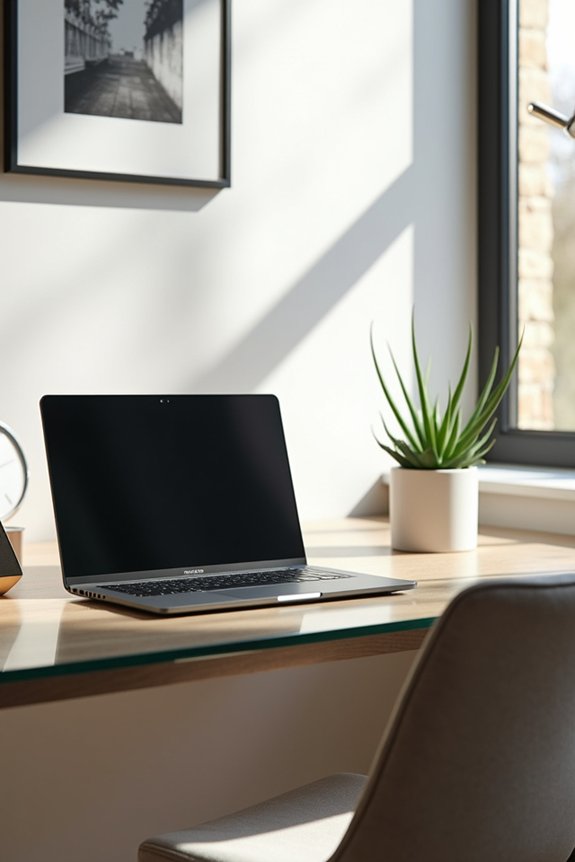
So which decorations can you actually write off? I’ve learned that the IRS allows deductions for items serving a genuine business purpose. Wall art that inspires productivity, desk lamps improving visibility, curtains reducing glare—these qualify for your home office deduction. Plants and rugs work too, provided they support workspace organization rather than purely aesthetic appeal.
Here’s what matters: your office decor must actively contribute to business use of home operations. I can deduct my filing cabinet’s decorative storage boxes because they organize client documents. That abstract painting? Not deductible unless it somehow boosts productivity.
Keep receipts documenting each item’s purpose. When I bought my task lighting, I noted it reduced eye strain during video calls. That connection between decoration and function makes ordinary office decor into legitimate tax deductions.
Direct vs. Indirect Office Decoration Expenses
When I set up my home office, I quickly realized that some decorations—like a custom filing cabinet built specifically for client files—counted as fully deductible direct expenses, while others, like fresh paint that brightened both my office and hallway, only qualified for partial deductions based on how much of my home I actually use for business. If you’re working with a mixed-use space, you’ll need to calculate your office’s percentage of your total home square footage, then apply that same percentage to indirect expenses like that paint or new lighting fixtures. I keep detailed receipts and photos showing exactly where each item sits and how it supports my work, which makes the IRS’s job easier and protects me during an audit.
Deductible Direct Decoration Costs
When I installed custom built-in cabinets exclusively for my home office, that became a direct business expense deduction. I documented it carefully because the IRS wants proof these items serve only work purposes. Custom shelving, office-specific lighting fixtures, and task-appropriate furniture all qualify as deductible direct costs.
I keep receipts showing exactly what I bought and how it functions solely for my business. Those directly assigned decorations become depreciation assets on my taxes. The straightforward rule: if it’s exclusively office-focused, I can write off the full amount. That distinction matters significantly when calculating what I actually owe.
Indirect Expenses Allocation Methods
Not everything in your home office gets the full deduction treatment. When I allocated my indirect expenses, I learned that shared items require a proportional deduction based on your business-use percentage. Here’s how I approach it:
| Expense Type | Example | Deduction Method |
|---|---|---|
| Indirect | General lighting | Business % of home |
| Indirect | Wall paint | Square footage ratio |
| Indirect | HVAC system | Proportional to office |
If your home office occupies 200 square feet of a 2,000 square-foot home, you’d claim 10% of those indirect expenses. This proportional approach allows you to deduct only what legitimately serves your business. I keep detailed receipts showing purchase dates and amounts, then multiply by my business-use percentage. It’s straightforward once you identify which expenses benefit your entire home versus your office exclusively.
Mixed-Use Space Considerations
Because your home office likely doubles as a guest room or multipurpose space, you’ll need to separate what counts as direct decorations from what’s indirect—and this distinction affects how much you can actually deduct. Direct expenses are purely business items like custom cabinets or wall-mounted whiteboards you use only for work. Indirect expenses cover general decorations benefiting your entire home, including the office portion. I learned this when I painted my mixed-use space. The wall color was indirect, but my floating desk shelving was direct. Document everything with receipts and notes explaining each item’s business purpose. This clarity protects your deductions and keeps you compliant with tax rules.
Simplified or Actual Method: Which Saves You More?

Which method you pick—Simplified or Actual Expenses—can significantly affect how much you save on your taxes, and there’s no one-size-fits-all answer. The simplified method works well if your office is under 300 square feet. At $5 per square foot, you’re looking at a maximum $1,500 deduction without tracking receipts. That’s straightforward.
However, if you’ve invested heavily in cabinets, quality lighting, or professional décor improvements, the actual expenses method might serve you better. I tracked every receipt last year—paint, furniture, storage solutions—and my total exceeded what the simplified method offered. You’ll need to separate direct expenses from indirect ones and calculate your business-use percentage. Compare both approaches before filing. The additional effort often provides better results.
Calculate Your Deductible Decoration Percentage

To figure out what you can actually deduct, I’d start by measuring your home office space—let’s say it’s 120 square feet in a 2,000 square-foot home, which gives you a 6% business-use percentage. Next, sort your decoration purchases into two buckets: direct expenses like that custom built-in shelving unit (100% deductible if it’s only in your office) and indirect expenses like paint or lighting (only 6% deductible since they benefit your whole home). Keep every receipt and jot down why each item matters for your work—a desk lamp is business-necessary, but that abstract art print probably isn’t, so you’ll want clear records to back up what you’re claiming.
Space Usage Allocation Method
you can’t just write off every throw pillow and desk lamp if your home office shares space with your guest bedroom or doubles as a craft room.
I learned this the hard way. The space usage allocation method lets you deduct decorating expenses based on your office’s actual square footage. Measure your home office—mine’s 120 square feet—then divide it by your total finished home square footage. If your house is 2,000 square feet, that’s 6 percent.
Direct items like custom shelving? Fully deductible. But indirect expenses, like nice paint that benefits your whole home, only count at that 6 percent rate. Keep detailed receipts explaining each item’s business purpose. This approach keeps you honest and audit-ready.
Expense Categorization And Documentation
Now that you’ve calculated your square footage, organize your decorating purchases into categories—because the IRS distinguishes between a custom built-in bookcase and a fresh coat of paint.
Direct expenses like custom cabinets used exclusively for business are fully deductible. Indirect costs—paint, lighting, flooring—get prorated based on your business-use percentage. I learned this when I deducted my entire office refresh without tracking which expenses fell into which category.
Here’s my current system: I keep receipts organized by category and document how each item serves my business purpose. A desk lamp qualifies as business use. New curtains get a notation indicating the percentage allocating to my office space. This approach to expense documentation separates direct versus indirect expenses clearly, making tax time smoother and keeping auditors satisfied.
Documentation: What the IRS Expects
When I first started deducting home office expenses, I learned the hard way that the IRS doesn’t take your word for it—they want proof. Solid documentation separates legitimate deductions from rejected claims.
The IRS doesn’t take your word for it—they want proof. Solid documentation separates legitimate deductions from rejected claims.
Here’s what I keep on file now:
- Original receipts showing purchase date, vendor, and exact amount
- Photos of each decoration item in your home office space
- Written descriptions explaining how each piece serves business function
- Measurements of your total home office square footage
- Records showing business-use percentage of your home
I learned this lesson when an auditor questioned my custom filing cabinet. Because I’d saved the receipt and taken a photo showing it held client files, I easily proved its business purpose. Now I treat documentation as a safety net—it’s there when I need it, giving me confidence in my deductions.
Seven Audit Red Flags to Avoid

Having solid documentation keeps you safe, but knowing what auditors actually scrutinize helps you stay off their radar altogether. Here’s what I’ve learned triggers scrutiny on home office deduction claims.
First, claiming purely decorative items like artwork or expensive rugs raises immediate red flags. Auditors know these aren’t business necessities. Second, office decoration expenses that seem excessive compared to your income look suspicious. I once saw someone claim $8,000 in décor for a 200-square-foot space—that invited questions.
Third, missing receipts for items over $500 are problematic. Fourth, vague descriptions like “office supplies” instead of specific items hurt your case. Fifth, deducting items used partially at home signals trouble. Sixth, inconsistent measurements between tax years confuse auditors. Finally, claiming deductions without clear business purpose documentation is asking for trouble.
Stay specific. Stay documented. Stay smart.
Claiming Decoration Deductions With Confidence
Once you understand what auditors actually look for, claiming decoration deductions becomes straightforward—you’re just being intentional about what you’re buying and why.
Keeping organized records is important. Here’s what I recommend tracking:
- Receipts showing purchase date, item description, and cost
- Photos of decorations in your home office space
- Notes explaining each item’s business function
- Square footage measurements of your workspace
- Documentation of deduction method chosen (Simplified or Actual Expenses)
When I furnished my home office, I chose a desk lamp specifically for task lighting—that’s deductible. But the decorative throw pillow? That stays off my taxes. The filing cabinet with custom labels for client folders? Absolutely deductible.
You’re building credibility by being honest about what truly serves your business. That honesty shows in your records.